Friday, February 23, 2018

The Islands of Knott's (Part I)

Detail from ride concept art, with Tiki and volcano added by author based on comments by Bud Hurlbut.
The greatest tiki theme-park ride of all time was nearly built in the last place you'd expect: The Old West-themed Knott's Berry Farm, in Buena Park, California. And at least a few reminders of that unrealized dream can still be found today. The lush tropical vegetation and Tiki-style picnic huts of "Jungle Island" (now called Knott’s Lagoon) are just a tiny hint of what was and what almost was.

The story of Knott's Berry Farm is a fascinating and complicated one, beginning with an actual berry farm in the 1920s, a wildly-popular chicken dinner restaurant (and diversions for waiting guests) developing in the 1930s, and a replica "Ghost Town" appearing in the early 1940s. But aside from rides on the Butterfield Stage, there weren't any real rides at Knott's until the 1950s, when ride builder and operator Bud Hurlbut approached a skeptical Walter Knott with the idea of putting in a Carousel. Ultimately he sold him on the idea. This hand-shake deal led to a second ride, and a third, and eventually to a decades-long business arrangement with Bud having the concession for most of the rides at Knott's. His most legendary achievements there were the Calico Mine Ride (1960) and the Timber Mountain Log Ride (1969) -- both of which are signature Knott's attractions to this day. Bud dreamed up, financed, built, owned and operated both of these landmark rides. 
Bud Hurlbut inspects a scene in his new Calico Mine Ride, 1960.
It was in the midst of those prime "thinking big" years -- when the mine ride was still incomplete -- that Bud began planning a South Seas "land," with an elaborate and ambitious South Seas Island Boat Ride.  In their book, Knott's Preserved, authors Chris Merritt and Eric Lynxwiler describe the area: "Clearly inspired by Disneyland's Jungle Cruise, the developing Lagoon area across Beach Boulevard would become home to an exciting tour around tropical islands with thrills along the way."

It was all to be built on land Knott owned on the opposite side of Highway 39 (Beach Boulevard) from the rest of "the farm."  Plans (shown below) were drawn in April of 1959.
Drawing of islands for Hurlbut Amusement by Dick Bagley, courtesy Christopher Merritt
In early January, 1960, Russell Knott, Walter's son and a key manager of the Farm, stopped by Bud's shop and found him mulling over ideas for the South Seas ride. He asked Bud to focus on getting the mine ride finished first.  But just days later, Bud and his associate, Dick Bagley, (who had worked on designing Disneyland's steam trains) were out eyeballing the proposed South Seas area again. Bud would also go for walks on the land with his wife, Lou, and his dog, Beagle, turning over the possibilities in his mind. Still perpetually steeped in the mine ride project, his mind naturally turned to mountains and caverns. Whatever else the boat ride had, it should certainly have both of those. But he really didn't have time to do more work on the project until the mine ride was completed. 

When the Calico Mine Ride opened on November 22, 1960, it was an immediate booming success. And it also allowed Bud to get back to his other plans. By Thanksgiving, he was already starting to think about the South Seas ride again. By New Years Eve he was discussing plans once again with his employees.
Exterior of the newly opened Calico Mine Ride, circa 1960.
In early 1961, Bud went to work creating the new ride's waterways, building up its islands, and planting the banks with tropical-looking foliage.

 “...I got a couple of bulldozers, you can see all the passageways in there," Bud told Chris Merritt in a 1998 interview. "One was the South Seas with the big volcano and lava running down. I was kinda concerned on how I was gonna make lava red hot running down. I don’t know if I ever really got that all worked out or not…”

Later concept art, referencing South Seas plans, showed an Island village scene, with thatched huts on stilts and outrigger canoes on the beach. And the ride almost certainly would have included waterfalls, large tikis, and a variety of fake wildlife.
"Leftover" South Seas Island Boat Ride scene in background of later "Fur Trapper Ride" concept art.
Bud said the ride "would have been pretty much like the Jungle Cruise." But the addition of tunnels and a huge erupting volcano hint at the way Bud's ideas tended to grow and become more elaborate over time. The boats would actually pass through caves UNDER the volcano, and one can only guess what the inventor of the beautiful stalactite/blacklight cavern in the Calico Mine Ride would have cooked up for the volcano's interior.  Just as the mine ride project grew from a straightforward dark ride into a multi-story mountain with special effects and many elaborate scenes, certainly the South Seas ride would have grown into something very special and unique.
Aerial photo of graded "islands" in South Seas area at Knott's, 1961.
Bud not only carved out the islands for the boat ride, but also an adjacent peninsula which he'd already identified as "Jungle Island." It's long been unclear what his plans were for Jungle Island, but according to an August 1961 article in Amusement Business magazine, Bud's plans for the overall area included not just the boat ride, but also "others in a South Sea theme." Dick Bagley served as the project's design engineer. 
Detail of Hurlbut map of proposed Jungle Island features. Courtesy Stack's Liberty Ranch
In 2018, the Facebook feed for Stack's Liberty Ranch -- an in-progress theme park museum and movie ranch -- posted two small portions of a March 19, 1959 "preliminary drawing" by Bagley for "Knott Jungle Island" featuring "some suggestions for points of interest, trails and signs." Elements depicted among the presumed tropical foliage included a climbing tree, a "boysen-berry bog" with a large plastic berry, a 10-foot by 15-foot "Knott's Cabin," a "Giggling lions den", "gay stepping stones," an underpass tunnel, another tunnel through dense brush, and such landmarks as "Laughing Springs," the "Chocolate River," "Ice Cream Cove," "Angry Cross-Roads," "Whispering Creek," and more.
This 1959 plot plan for the South Seas Island Boat Ride appeared on Ebay around 2015.
But something happened, and suddenly the whole South Seas project was on hold. The" islands" just sat, with no water around them. In another interview, for "E" Ticket Magazine #35, Hurlbut told Merritt, "We got as far as digging the troughs... and then we abandoned the idea because we had some other more important things to do."
Clearer detail of drawing above, courtesy Ken Stack of Stack's Liberty Ranch.
Today, Merritt says that during his many conversations and formal interviews with Bud, he was never given a definitive answer about why the South Seas project stopped. John Waite, an longtime employee and good friend of Bud's,  said the subject was never raised. He says he was only aware of the project because he once saw a "neat sketch of the boat" that was to be used for the ride. (Evidence suggests the final boat design would have looked similar to Disneyland's Jungle Cruise boats, but possibly with thatched awnings.)

Today, there's little known evidence of the great South Seas project at Knott's. The sources cited in this article and a single crude tiki mask -- which I acquired at Bud Hurlbut's (home) estate sale -- provide some evidence of his interest in the Polynesian theme.
Bud Hurlbut's Tiki mask. From the collection of Chris Jepsen.
Next time: Part II -- What Became of Jungle Island!?!

Sunday, August 6, 2017

Tustin's Tahitian Terrace

Pool house at the Tahitian Terrace, Tusin, 2017
Sometimes the best way to do urban archaeology is just to find a spot that interests you and start digging. This is one of those times. I'll get the ball rolling, and perhaps someone else will jump in with additional information or new leads to follow.

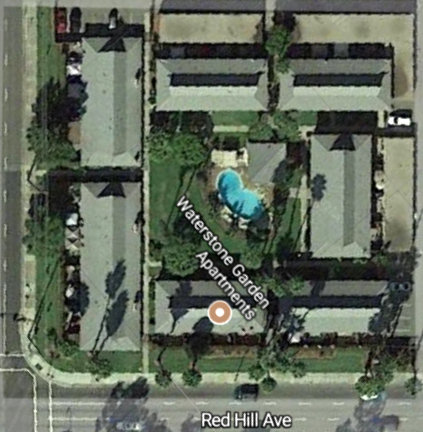
Years ago, an apartment complex (now called Waterstone Garden Apartments), at the north corner of Red Hill Ave. and Walnut St. in Tustin, California, caught my eye for it's mid-century Tiki design. Recently I stumbled across a couple photos of the place when it was only four years old, and I was inspired to not only drive over and photograph the place anew, but also to spend a bit of time looking for more of its story.  Here's what I've found so far,...
The Tahitian Terrace apartments in 1967
Waterstone Garden was once two separate developments with complementary Polynesian themes. The first, situated right on the corner at 14441 Red Hill, was the Tahitian Terrace complex.
The Tahitian Terrace was built in 1963 -- just a year after Stouffer's Tahitian Terrace restaurant opened at nearby Disneyland -- and began renting units that same summer.
It's one of a relatively small handful of Orange County complexes that have made it to 2017 with much of their original Tiki style still in place. One must assume that a good deal of Tiki decor has disappeared, including the pitched A-frame entryway which has now been replaced with a conventional awning. But much of the original vibe remains.
Aerial photo from 1963 courtesy the Orange County Archives.
The aerial photo below shows the Tahitian Terrace under construction (on the left and center), with another complex next door, the Whispering Woods, still only in the process of being graded (on the right). Notice that both complexes were -- like so much local development at that time -- simply carved out of the orange groves.
Some newspaper ads for Tahitian Terrace promoted "island luxury."
The second complex now folded into "Waterstone Garden" was the thirty-unit Whispering Woods, at 14421 Red Hill Ave. This second complex was built for real estate investment wiz James T. Bakos of Rossmoor by the Valencia Construction Co. The landscaping was designed by Hugh Paulsen. Although grading began while Tahitian Terrace was still under construction, Whispering Woods was still unfinished as late as spring of 1964. Once finished, no children or pets were allowed, and like its neighbor, it bragged about being "all-electric."
The Whispering Woods, 2017
Unfortunately, much less is known about the origins of the Tahitian Terrace, except that the land was surveyed in 1957 by then-owners Mr. & Mrs. Albert Nieblas, who seemed to be movers-and-shakers in the Tustin business and social scene at the time.

In its first years, newspaper ads promoted Tahitian Terrace as featuring "Island Luxury," which sort of sounds like an oxymoron. (I'm picturing Thurston and Lovey Howell driving around in a pedal-powered Mercedes made of bamboo.)
The Whispering Woods, 2017
Although taking a less-than South Seas-inspirted name, the Whispering Woods' lava rock chimneys and planters, A-frame pool house, nautical wormwood facades, tropical landscaping and other details reflect a faux-Polynesian influence, even today. Was it intentional?
Aerial photo of the Tahitian Terrace apartments, late 2010s
Eventually, the Tahitian Terrace and the Whispering Woods were brought together under the flavorless yet Flintstones-like moniker, "Waterstone Garden Apartments." Of the two, the Tahitian Terrace half offers the most reward for today's Tiki-appreciating urban archaeologist.
Even the carports behind the Tahitian Terrace have South Seas rooflines.
One suspects that there was more of decorative element to some of the buildings once, especially the two-story buildings that now seem so bland once you get below their Tiki rooflines. So many of these kinds of places lost a great deal in being de-Tiki-fied, and it seems like that happened here as well. Still, the rooflines, the outrigger beams, the lush tropical landscaping, and the wonderful pool house make the Tahitian Terrace worth a stop.
Inside the Tahitian Terrace courtyard, 2017.
The Whispering Woods seems to continue with its identity crisis: Is it or was it Polynesian themed, or did its rustic version of 1960s architecture combined with tropical landscaping and lava walls just give that impression? Perhaps more information will come to light on both complexes in the future. In fact, part of why I'm posting this is in the hope that those who know the story of this corner of Tustin will come forward and share what they know.
The Tahitian Terrace apartments in 1967

Thursday, June 29, 2017

Photos from "Tiki In Orange County"

Many photos from my Tiki In Orange County exhibit at Chapman University are now posted in an album on my Flickr account. If you took more photos, let me know and I'll post them, too! The exhibit remains up through late August.

Tuesday, February 21, 2017

Tiki on KUCI

Ellen Bell, host of "Vintage Orange"
I’ll be talking about my new “Tiki In Orange County” exhibit and all things Polynesian Pop on Ellen Bell’s Vintage Orange radio show on KUCI, 88.9 FM on Wed., Feb. 21, 2017, from 4:00 p.m. to 4:30 p.m. The Podcast version should be posted to her blog sometime later in the week.

Visiting with Ellen is always great fun, and I’m looking forward to the interview!

I’ll also be giving a little tour of the exhibit to Chapman University staff and faculty on Thursday at 4:00 p.m. This will be the little sneak preview sampler platter version, and not the big opening event, which will be on March 4th, which anyone can attend (if they RSVP).

Monday, February 13, 2017

"Tiki In Orange County" exhibit

I'm curating an exhibit at Chapman University called "Tiki In Orange County," which through August 25. The big kick-off event/reception/program is March 4th, and I hope to see you there! (Bring your friends and family, but please click through and RSVP so we know how many little paper umbrellas we're gonna need.)

Quoth the promotional blurb,...
Chris Jepsen, Guest Curator, presents Tiki in Orange County, on display in the Frank Mt. Pleasant Library of Special Collections and Archives. From architecture, décor and music to literature, theme parks and backyard luaus, the South Seas was a wildly popular theme throughout mid-twentieth century America. Artifacts, photographs, documents and music, offer a look at the origins of Tiki in the South Pacific, its interpretation in mid-century Orange County (and Southern California), and how both have inspired today’s Tiki revival.

Opening Reception: Saturday, March 4, 2017, 4:30 - 6:30 p.m.

Location: Special Collections and Archives, 4th Floor

Exhibit hours are Monday through Friday 10:00 a.m. to 5:00 p.m.

Visitor parking is available with purchase of a temporary permit. For parking fees, maps & directions, visit: www.chapman.edu/map
Thanks not only to my gracious aforementioned hosts at Chapman, but also to the amazing folks who loaned, installed, or helped me create parts of this exhibit, including Stephanie George, Carlota Haider, Kevin Kidney, Jody Daily, Ben and Vicki Bassham, Bob Van Oosting and Leroy Schmaltz of Oceanic Arts, Scott Schell, Dylan Almendral, Sven Kirsten, Jason Schultz, Gail Griswold, Eric Callero, Laurie Gates Cussalli, David Eppen, Patrick Jenkins, the Orange County Archives, the Santa Ana Historical Preservation Society, the American Heritage Museum, and Jane Newell and Patricia Grimm of the Anaheim Heritage Center. It's an honor to know these people and I apologize in advance if I've forgotten anyone.

Thursday, August 4, 2016

A Word On Home Tiki Bars...

Hawaiian Airlines' in-flight magazine just did a photospread about home Tiki bars. Of course, I love to see the photos, but what really grabbed me was this quote, courtesy the always-insightful Humuhumu Trott. See her review of the article -- from whence I stole the image above -- at Critiki.com.

Wednesday, June 1, 2016

The Royal Hawaiian Rides Again?

Just before Christmas, I was walking through downtown Laguna Beach, California and stopped to photograph the old Royal Hawaiian (331 N. Coast Highway) through the windows. The landmark restaurant closed in 2012, after 65 years in business, and has been vacant ever since. Francis Cabang originally opened the place in 1947, and it was amazing. It was like walking into a native village deep amid the jungles of a South Seas island. There were Tikis, puffer fish lamps, bamboo, tropical gardens, thatched huts to dine under, "wiki wiki platters," and a delicious signature Lapu-Lapu so big it gave the waitresses carpal tunnel syndrome. Prices were low, portions were ample, and it was a favorite both of locals and out-of-town visitors.

But the  Cabang family sold the place in 2006, and the new owners did a major remodel. The amazing decor was mostly removed, their prices went up, their Lapu-Lapu shrank (a common problem when reaching age 65), and Hawaiian music was replaced with live rock in the evenings. Although this half-assed Royal Hawaiian was better than no Royal Hawaiian, few were surprised when it closed in 2012.
Flash forward again to this past December. As I was shooting photos through the Royal Hawaiian's windows, a man came up and asked what I was doing. I explained about being a historian. He introduced himself as Mo, the restaurant's new owner, and that he planned to re-open the Royal Hawaiian. He also very kindly offered to let me go inside to take better photos. He was waiting for other people to join him there for a meeting. I shot a whole bunch of photos inside, some of which I'm posting here. (More of my Royal Hawaiian photos, past and present, are posted on my Flickr account.)

While snapping photos, I tried to sound Mo out on his thoughts re Polyensian Pop and Tiki, but he didn't have much to say one way or the other. I suggested he research the subject  if he was going to reopen this iconic Tiki establishment. I told him a little about the Tiki revival and suggested he read Sven Kirsten's books, visit the Tiki swapmeets, wander the aisles at Oceanic Arts, etc. He was polite, but I wasn't sure if I was connecting or not. He did say that he wanted to reflect the kind of atmosphere one sees in today's better restaurants on the Hawaiian islands.
So today I saw this article entitled "Royal Hawaiian Reopens in Laguna Beach" in the online version of Locale Magazine (May 31, 2016). It reads, in part,...
"Today, it is owned by Mohammad Honarkar, and he and his hospitality team—Eric Bostwick, Carlos Godinez, Hasty Honarkar, Dylan Marsh and Brian Smith—are dedicated to bringing this historic restaurant back to life with a new and improved twist. 
"...The Royal Hawaiian will feature décor that will only be slightly updated from the previous renovations. Classic tiki vibes will be present, but will be combined with a new age feel that will ...make Laguna feel as though it has become a modern version of Hawaii. The Royal Hawaiian’s return will feature a menu that is filled with classic Hawaiian dishes made more unique with creative twists and many colorful handcrafted cocktails. Returning customers will also see the homecoming of the famous Royal Hawaiian Ribs and the popular cocktail dubbed the Lapu Lapu."
I'll start by thanking these folks for reopening what was once among the last great vintage Tiki establishments. I wish them luck and I'll definitely come try it shortly after it opens. And if it's good, I will certainly be a repeat customer. But here's my two cents:

First, they need to roll back the misguided changes made by the last owners, not double-down on them with more modernization. It's time to hire "Bamboo Ben" Bassham or Daniel "Tiki Diablo" Gallardo to re-tikify the interior, and hire someone who knows vintage Tiki cocktails to get the bar off to a good re-start. And yes, the menu needs some amusingly non-authentic favorites, like the old "Pele Goddess of Fire" (a scoop of vanilla ice cream with a flaming sugar cube in the middle).

When you buy a restaurant like the Royal Hawaiian, nostalgia is your biggest asset. You get a built-in audience and a line at your door on opening night. But that same nostalgia requires a certain willingness to commit. Let's hope the new folks "get it." There's nothing worse than disappointing an enthusiastic built-in audience. (Just ask George "Stinky Prequels" Lucas.) On the other hand, play your cards right and you'll be the most popular place in town. Again!