

Exploring the history and aesthetics of the Mid-Century Tiki/Polynesian Pop phenomenon, along with its influences, impacts, by products, and revivals. Written in a mysterious sea cave in Orange County, CA.
Friday, September 28, 2012
Return to the Quiet Village

Sunday, September 16, 2012
Pete & Portia Seanoa

 The result was the following article, which ran under the title, "The Enchanted Tiki Home," in the Aug. 2001 issue of Otto von Stroheim's trailblazing "'zine," Tiki News, (Issue #17). Today, the Seanoas live in Land O' Lakes, Florida, where Portia still teaches community classes in the ancient Kahiko style of hula and teaches about Polynesian and Hawaiian cultures. Their son, Nuufolau Joel "Samoa Joe" Seanoa, has followed the family showbusiness tradition as a professional wrestler.Sadly, the tikis in front of their old house are gone.
 I have tweaked this article a bit for re-publication here, and it now has more color illustrations -- But it still remains largely as it appeared in print in 2001,...
Motorists on busy Slater Avenue in Huntington Beach may be puzzled by the large tikis and tropical foliage surrounding the Seanoa home. Few know Pete Seanoa's story -- A story that includes lions, Elvis Presley, Walt Disney and the preservation of Polynesian heritage.
"I came to this country from Samoa 40 years ago," said Seanoa. "I had no education, but I had a strong sense of who I was and what we were about. Polynesian culture and history isn't recorded, but it's passed down from generation to generation."
One of the traditions passed down in the Seanoa family was the carving of tikis. Sometimes five or six family members work together to carve a tiki from the corewood of palm trees. It's not something they do often, but they feel it is an important tradition to keep alive.

For Seanoa, tikis and tiki carving are deeply rooted in the spiritual world.
"The tiki signifies the spiritual force within.," he said. "Tikis tend to get chop-sueyed in with other cultures, like Alaskan totems, but they're totally different. They aren't gods, but they represent the spiritual world in general. Mostly, they represent the happy spiritual elements. The spiritual aspects of the carver go into the tiki. What he feels about his culture goes into it."
Each tiki he carves, said Seanoa, "symbolizes me, symbolizes protection and symbolizes our people."

"For us, it's a sense of security," he said.
Ironically, he points out that some of the tikis that provide this sense of security have been stolen from his yard. "What are [the thieves] going to do with them?," he asked. "What does it mean to them?"
Today, there are five large tikis in Seanoa's front yard, representing carving styles from numerous Polynesian islands. Four more stand guard over the back yard, amid fishing nets, starfish and other tropical decor. The tallest of the tikis, the Tahitian giant in the side yard, stands nine feet tall and has painted yellow highlights.

However, Seanoa feels the tikis he has sold are of limited significance. He has little interest in carving tikis for sale these days.
"If it sells, it's not spiritual anymore. A lot of people duplicate [tikis] and it's just a prop."

Originally, said Seanoa, the Tahitian Terrace and the Enchanted Tiki Room attraction "were supposed to work together," with diners being entertained by singing tikis and robotic birds while they ate. However, as the project evolved, the restaurant became a separate entity with its own live entertainment.
Seanoa attributes the closure of the Tahitian Terrace to changes in management.
"The Disney family used to have control, but everything changed in the 1980s," he said.

Currently, Tiare Productions' dancers perform frequently at Cafe Tu Tu Tango at The Block shopping center in Orange. Shows are usually on Friday or Saturday evenings.The dancers practice in the Seanoas' backyard on weekends.
"They play enjoyable Polynesian music on Saturdays," said one neighbor with a smile.
Sunday, September 9, 2012
Wayne Coombs, R.I.P.


Otto von Stroheim of Tiki News and Tiki Oasis fame, writes, "Wayne Coombs was a self made businessman, renegade carver, pioneer and flag bearer of Tiki, and a friend of mine. It saddens me to announce that he has moved on to the big carvers union in the sky and can no longer enrich our lives."
Friday, September 7, 2012
The Royal Hawaiian, Laguna Beach
 |
| Old placemat courtesy Bob and Leroy at Oceanic Arts. |
To that link, I will also add the following tale, of my first visit to the Royal Hawaiian -- long before it changed hands and long, long before it closed:
 |
| The Royal Hawaiian's back bar, shortly before it closed. |
The menu was a time machine set for 1950s America. The food was about as Hawaiian as I am. The exotic "Wiki Wiki Platter," for instance, was simply a steak with a baked potato wrapped in tinfoil. The only island theming to be found in the food was the ring of pineapple on the edge of my plate. My dinner also came (as did pretty much everything) with a thinnish French onion soup and a small salad drown in blue cheese dressing and served in a laminated wood bowl. It was all perfectly good food at a rather reasonable price. Your grandparents would have felt right at home, and so did I.
The jaw-dropper was the house drink, the Lapu Lapu -- a faux-Polynesian drink named after a Filipino warrior chief from the sixteenth century. The drink was outstanding, and came in a glass the size of,.... well,... You know that enormous brandy snifter your great uncle used to keep on top of the piano? The one that held his entire matchbook collection? It was like that. Clearly, it was a drink for sharing with friends.
But I held out the greatest hope for dessert. I had spied an item on the menu called "Pele: Goddess of Fire." There was no description, and I asked for none.
It was impossible NOT to order any dessert so audaciously named. The anticipation grew. We waited. And then,... suddenly,... out of the plastic jungle came our waiter, carrying (drum roll, please),... PELE: GODDESS OF FIRE!
It was a small dish with one scoop of vanilla ice cream, surmounted by a sugar cube that had been soaked in umpteen-thousand proof alcohol and set on fire! My Mid-Century faux-Hawaiian dining experience was complete.
Oh, Royal Hawaiian, you will be missed!

Monday, September 3, 2012
International Tiki Marketplace

Anyway, it's not a huge event, but it's growing. And it's a lot of fun to see what local tiki artists are creating and what tiki collectors are cleaning out of their garages. Also, there's live entertainment from some great "hapa haole," Hawaiian, and exotica bands. And I almost always run into people I know here. It's as much a social event as anything else.


Wednesday, August 29, 2012
The Exotic Sounds of... Wally George?
 |
| (Artist's concept of Wally as a bongo hep-cat.) |
Wally’s “Hot Seat” show, which began on Anaheim’s KDOC-TV in 1983, was clearly the direct ancestor of much of our current daytime television. Wally’s guests all clashed with him, and each episode became a melee of screamed insults and attempts to out-shout each other. His young studio audience chanted “Wah-lee!, Wah-lee!” in a way that would be very familiar to fans of Jerry Springer. Wally took an ultra-right-wing stance on everything, but he was much more focused on being contrarian and shocking (to the point of farce) than political. In his day, he was an iconic Southern California character.
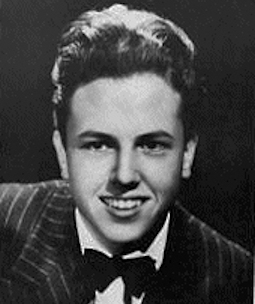 |
| New radio personality Wally George, in 1948. |
But here’s another strange fact you didn’t know: Wally was a music critic for the Los Angeles Times in the 1950s and 1960s, and he clearly had an interest in South Seas-style exotica: the music of tiki.

Aug. 18, 1957: "EXOTICA -- This is Martin Denny and some strange sounds that are supposed to suggest the exotic, mysterious Orient. Oddly enough, they do just that. Not the Hong Kong bamboo sticks and cymbals type of musical cliché, but music that delights the ear with unusual effects, yet remains commercial enough to be commercial. Emerging from Honolulu's Hawaiian Village, Denny Statesided it to Las Vegas where his clicking sometimes became confused with the clicking of the silver dollars."
Dec. 1, 1957: "Several months ago, we reviewed an unusual Liberty LP by one Martin Denny and orchestra. Entitled EXOTICA, it was an excitingly different record soundwise and its sales have proved that thousands thought as we did. Now comes [EXOTICA II], in the same vein, a definitely exotic blend of music combinations suggesting Polynesian and Oriental influences... Les Baxter's orchestra on Capitol's PORTS OF PLEASURE takes an uneventful voyage to various Far East ports. Orchestration is, as always with Mr. B., clever and sprightly. However, the melodies themselves seem to be going nowhere."
Apr. 20, 1958: "TABOO -- Here is another one of those ‘strange sounds from the jungle’ records highly reminiscent of Martin Denny's recent EXOTICA. This one is by Arthur Lyman and was recorded in Henry Kaiser's aluminum dome outside the Hawaiian Village Hotel in Honolulu. The sound is excellent and Lyman's conception of 'Caravan' and 'Katsumi Love Theme' is admittedly intriguing. This LP has been getting big play from the disc jockeys of late, so you may already have become familiar with it.”
Sept. 14, 1958: "...We reviewed an LP entitled TABOO [from] Arthur Lyman. Now comes not one, but two, companion albums: HAWAIIAN SUNSETS and BWANA A. Both contain the same exiting mélange of sounds captured by Mr. Lyman in his initial waxing. The former has such fare as 'Hawaiian War Chant,' 'Sweet Leilani,' etc.; the latter, 'La Paloma,' 'Colonel Bogey's March,' etc. The Hawaiian album is enough to rekindle an island flame in the jaded. Verdict: A delicate journey into the exotic.”

Sept. 6, 1959: "While the much heralded return of the big band has as yet failed to materialize, we do have in our midst another musical phenomenon -- exotic music. One of its top practitioners, Martin Denny, has come forth with another of his slick releases, QUIET VILLAGE. Although this is anything but a big band the six musicians on this LP manage to make as much noise as many larger orchestras. As with the six previous Denny efforts, the music has the charm of the islands, or perhaps, the call of the wild. Denny relies almost entirely on percussion instruments to create his illusions, and one of his helpers, August Colon, supplies bird calls. Unless our ears deceive us, Mr. Colon has been padding his part. This is not necessarily a criticism, just an observation; at times you get the feeling you're locked in a bird sanctuary..."
Oct. 4, 1959: "For a change of pace try BAHIA with the exotic sounds of Arthur Lyman..."
June 5, 1960: “EXOTIC SOUNDS FROM THE SILVER SCREEN -- Here is another outpouring of bird calls and the like from Martin Denny. This is up to his previous high standard, but up to last count this is his 10th LP. So enough, already."
Jan. 29, 1961: "Martin Denny, always a bit wild with weird sounds even on monaural discs, serves up a doubly tempting portion via stereo. His latest: EXOTIC PERCUSSION. This offers among other things--tuned Burmese gongs, piccolo xylophones and boo bams..."

Saturday, August 25, 2012
Introduction to Tiki

It began gradually with pre-War bamboo bars and reached critical mass with Trader Vic's and Don the Beachcomber -- the two restaurants that invented the initial canon of tiki decor and drinks and associated them with fine dining and good times. The theme's popularity grew rapidly in the years following World War II, and peaked around the time of Hawaii's admission to the Union in 1959. Many of the service men who'd been in the Pacific Theater remembered the beauty of the islands, in spite of the horrible events that occurred there. New popular restaurants like The Luau in Beverly Hills refined the tiki decor and menus even further. Thor Heyerdahl's bestselling Kon-Tiki (1950) and James A. Mitchener's Tales of the South Pacific (1947) -- which later became a popular musical -- also fed the trend.
 |
| Entrance to the "Hidden Village" at Sam's Seafood, Sunset Beach, CA. |
Certainly, we can dissect a favorite tiki haunt into its component parts, and admire and study each element for what it is: Masks from Papua New Guinea, war clubs from Tahiti, cartoon-like carved tikis from a nearby nursery, "Chinese" foods invented in New York, Latin-infused jazz from the hotel lounges of Hawaii, etc., etc. But it was the combination of all these elements and more that was instantly recognizable as tiki style. At its worst, it was ham-fisted and cheesy. But at its best it was beautiful, evocative, and mysterious, and provided an instant escape from modern life into an exotic fantasy world.
The tiki juggernaut continued well into the 1960s, but was already sputtering to an end by the time the 1970s arrived. From then on, the classic examples of the style were under assault by real estate developers and changing tastes. Even iconic sites like the popular Kahiki Supper Club in Ohio (on the National Register of Historic Places) were bulldozed.
 |
| New tikis for sale at Bamboo Ben's "garage sale" event, May 2010. |
Yes, the revival has been marked with more than its fair share of plasticky Chinese knock-offs and junk. And some folks think hanging a cheap Indonesian mask and a fishnet over their barbeque makes them the next Trader Vic. But there is also quality, creativity, and tiki wonderfulness to be found again. And some of the few remaining authentic tiki remnants of the 1950s and '60s have gotten the shot-in-the-arm they need to survive a little longer, so we can study them, enjoy them, and consider what they can tell us about their era, about their origins, and about ourselves.
The tide has definitely turned.
Subscribe to:
Posts (Atom)